A specialization-by-specialization guide to what you’ll study, who it suits, and where it can take your career.
Most online MBA programs in India ask you to choose a specialization by the start of Year 2 — after a common foundation year covering subjects like marketing management, financial accounting, operations, and organizational behavior. That choice shapes roughly a third of your coursework and, in many cases, the first few years of your post-MBA career.
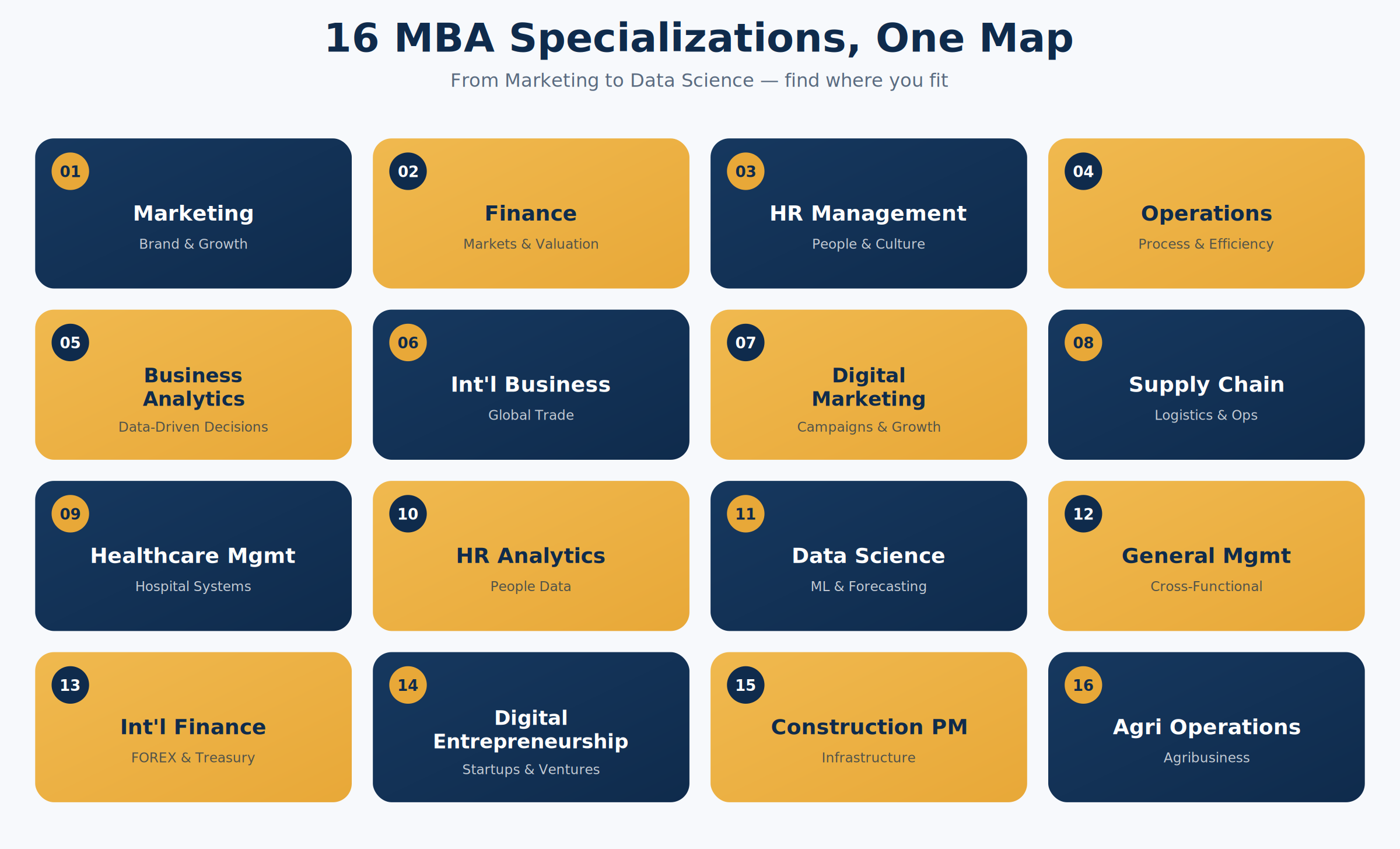
Save or share this map — then read the full breakdown of each specialization below.
The problem is that specialization lists differ from university to university, and the names alone don’t tell you much. “Business Analytics” at one university might be built around Excel and dashboards; at another, it edges into the same territory as a Data Science track. Reading only the subject titles on a brochure rarely tells you which is which.
Below is a plain-language breakdown of these 16 specializations commonly offered across Indian online MBA programs — drawn from actual curricula rather than marketing copy — covering what each one actually teaches, who tends to do well in it, and the roles it typically leads to.
Quick Facts
| Specializations covered | 16, drawn from university curricula across India |
| When you choose | Usually at the start of Year 2 (Semester 3) |
| Typical specialization credit load | ~16 credits out of ~100 total program credits |
| Still undecided? | Use our MBA Specialization Finder quiz |
The 16 specializations at a glance
| Specialization | Best for | Typical roles |
|---|---|---|
| Marketing | Creative + analytical thinkers | Brand Manager, Marketing Manager |
| Finance | Numbers-driven, detail-oriented | Financial Analyst, Investment Banker |
| Human Resource Management | People-first, strong communicators | HR Manager, Talent Acquisition Lead |
| Operations Management | Process and efficiency-minded | Operations Manager, Plant Manager |
| Business Analytics | Data-curious, comfortable with tools | Business Analyst, Data Analyst |
| International Business | Global outlook, cross-culturally adaptable | Export Manager, Trade Analyst |
| Digital Marketing | Digital-native, campaign-driven | Digital Marketing Manager, SEO/Growth Lead |
| Logistics & Supply Chain Management | Systems thinkers, planners | Supply Chain Manager, Logistics Head |
| Hospital & Healthcare Management | Interested in healthcare systems | Hospital Administrator, Healthcare Ops Manager |
| HR Analytics | HR professionals wanting data skills | People Analytics Lead, HRBP |
| Data Science | Technical/quantitative background | Data Scientist, Business Intelligence Analyst |
| General Management | Broad career goals, entrepreneurs | General Manager, Management Consultant |
| International Finance | Finance professionals eyeing global markets | Treasury Analyst, FOREX Manager |
| Digital Entrepreneurship | Founders and intrapreneurs | Startup Founder, Innovation Manager |
| Construction Project Management | Engineering/real estate background | Project Manager, Site Operations Head |
| Agri Operations Management | Interested in agribusiness | Agri Supply Chain Manager, Rural Marketing Lead |
Detailed breakdown
1. Marketing
Brand management, integrated marketing communication, consumer behavior, product management, and sales-and-channel strategy.
Students who enjoy customer psychology as much as building a go-to-market plan, and are comfortable switching between creative thinking and campaign metrics.
Brand Manager, Product Marketing Manager, Category Manager, Sales & Marketing roles across FMCG, retail, and consumer tech. Also one of the most transferable specializations into general management or entrepreneurship.
2. Finance
Corporate valuation, mergers & acquisitions, derivatives, and security analysis & portfolio management.
Detail-oriented students comfortable with numbers, financial statements, and regulatory frameworks.
Financial Analyst, Investment Banking Associate, Equity Research Analyst, Corporate Finance Manager — in banking, NBFCs, and corporate finance teams. Pairs well with CFA if aiming at investment roles.
3. Human Resource Management
Talent management, compensation & rewards, learning & development, and industrial relations.
People who enjoy mediating, structuring processes, and thinking about organizational culture rather than just administration.
HR Manager, Talent Acquisition Lead, Compensation & Benefits Specialist, HR Business Partner. A natural next step from HR generalist or recruitment roles into strategic HR.
4. Operations Management
Procurement, service operations, total quality management, and production planning & scheduling.
Students who think in processes and want to improve how things get built, delivered, or run day to day.
Operations Manager, Plant Manager, Process Excellence Lead, Production Planning roles in manufacturing and services. Especially useful for engineers moving into management.
5. Business Analytics
Spreadsheet modeling, visual analytics, social media analytics, and marketing/financial forecasting.
Students comfortable with tools like Excel, R, or Power BI who like translating data into decisions — without necessarily needing a coding background.
Business Analyst, Data Analyst, Marketing Analytics, Reporting/Insights roles across nearly every industry. Demand has grown quickly as every function is pushed to justify decisions with data.
6. International Business
Export-import management, international marketing and finance, and trade finance & FOREX management.
Students with a global outlook, comfortable navigating cross-border regulations and cultural differences.
Export Manager, International Trade Analyst, Global Account Manager, and roles in import/export or multinational supply operations.
7. Digital Marketing
Digital consumer behavior, brand management online, performance marketing, and digital strategy.
Students already comfortable with platforms like Google Ads and Meta, wanting formal grounding in the strategy behind them.
Digital Marketing Manager, SEO/SEM Specialist, Growth Marketing Lead, Social Media Strategist. Rewards students who keep learning outside the syllabus as platforms evolve.
8. Logistics & Supply Chain Management
Warehouse management, supply chain strategy, sustainable supply chains, and supply chain modeling.
Systems thinkers who enjoy planning and optimizing how goods and information move.
Supply Chain Manager, Logistics Manager, Procurement Lead, Warehouse Operations roles across manufacturing, e-commerce, and retail. Hiring has widened fast with e-commerce and quick-commerce growth.
9. Hospital & Healthcare Management
Hospital planning, clinical and support services management, healthcare IT, and community health.
Students with an interest in healthcare systems, whether or not they have a clinical background.
Hospital Administrator, Healthcare Operations Manager, Quality & Accreditation roles, healthcare consulting. Strong fit for professionals already in hospital administration or health-tech.
10. HR Analytics
People analytics, workforce planning models, and data-backed talent decisions — a more quantitative offshoot of HR.
HR professionals or aspirants who want to add a quantitative edge to a people-focused career.
People Analytics Lead, HR Business Partner, Workforce Planning Analyst, Compensation Analytics roles — increasingly valued at larger organizations.
11. Data Science
Statistical modeling, machine learning fundamentals, and business intelligence tools, applied to business problems.
Students with a technical or quantitative undergraduate background (engineering, statistics, commerce with strong math) wanting a business lens on data skills.
Data Scientist, Business Intelligence Analyst, Data Analytics Consultant, Decision Science roles. Without a technical background, Business Analytics is usually the more realistic starting point.
12. General Management
A broad curriculum across marketing, finance, HR, and operations rather than narrowing into one function.
Students undecided on a functional path, already running or planning to run a business, or wanting maximum flexibility for a generalist leadership track.
General Manager, Management Trainee, Business Development, cross-functional leadership roles. Also a sensible default if your employer sponsors the MBA without a specific functional requirement.
13. International Finance
A finance track weighted toward global markets — FOREX management, international financial reporting, and cross-border investment.
Finance-inclined students specifically interested in treasury, currency markets, or multinational finance operations.
Treasury Analyst, FOREX Risk Manager, International Finance Analyst, roles in export finance. Suits students who already have a Finance/Commerce background wanting to specialize further.
14. Digital Entrepreneurship
Venture building, digital business models, and innovation management, often alongside design thinking.
Students actively planning to start a business or lead innovation within an existing one, rather than pursue a traditional corporate ladder.
Startup Founder, Innovation Manager, Product Owner, roles in venture-backed or early-stage companies. Less about a guaranteed job title, more about the toolkit to launch or run something of your own.
15. Construction Project Management
Project management principles applied to construction, infrastructure, and real estate — scheduling, cost control, and site operations.
Students with an engineering, architecture, or real estate background looking to move into management.
Project Manager, Site Operations Head, Real Estate Development Manager, Infrastructure Planning roles. Works best as an add-on to an existing technical qualification, not a substitute for one.
16. Agri Operations Management
Agri-economics, agri supply chains, rural marketing, and micro-finance.
Students interested in agribusiness, food processing, or rural markets — a niche but growing option.
Agri Supply Chain Manager, Rural Marketing Manager, Agribusiness Consultant, roles with agri-input, FMCG, or food-processing companies. Fewer universities offer this track, so check availability first.
How to actually pick one
Reading a list of specializations tells you what’s offered — it doesn’t tell you what fits. If you’re weighing two or three of these against each other, our earlier guide on how to shortlist your MBA specialization walks through a practical framework: a three-layer test (past, present, future), a capability-gap audit, and a decision matrix to compare your final options side by side. You can also try our MBA Specialization Finder quiz for a quick, data-backed starting point.
Frequently Asked Questions
Which MBA specialization has the best job opportunities in India?
Finance, Marketing, and Business Analytics consistently have the broadest hiring demand across industries. Operations and Business Analytics have grown fastest in recent years as companies invest more in process efficiency and data-driven decisions.
Can I switch careers with an MBA in a new specialization?
Yes, this is one of the most common reasons professionals choose specializations outside their current field — for example, an engineer moving into Business Analytics or Operations Management. The specialization gives you formal grounding, but real-world transition also depends on internships, projects, and networking in the new field.
Do all universities offer the same MBA specializations?
No. Core specializations like Marketing, Finance, HR, and Operations are offered almost everywhere, but newer options like Data Science, Digital Entrepreneurship, or HR Analytics vary by university. Always check the specific university’s specialization list before applying if a niche area matters to you.
Is Business Analytics different from Data Science in an MBA?
Yes. MBA Business Analytics focuses on using data tools and dashboards to support business decisions, with less coding depth. MBA Data Science goes further into statistical modeling and machine learning, and is better suited to students with a stronger technical or quantitative background.